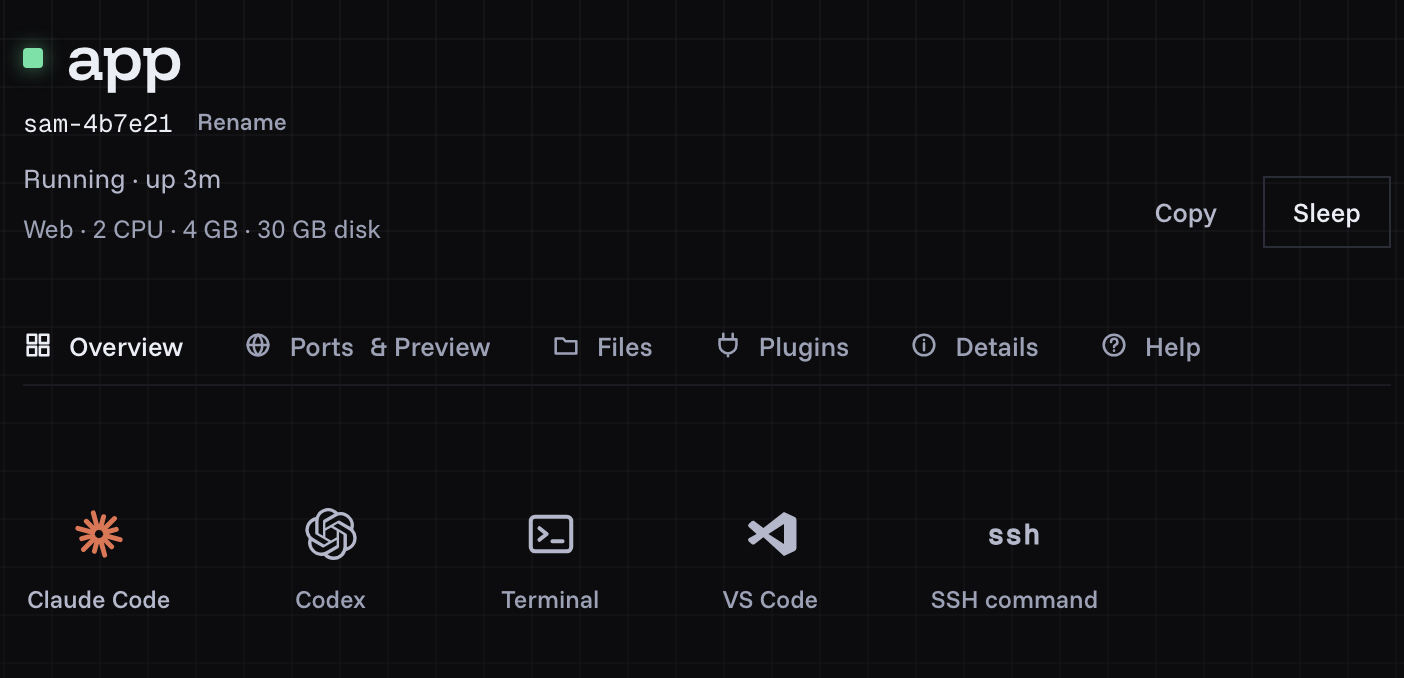
A shedix machine's page: Claude Code, Codex, a terminal, VS Code and SSH, each one click.
## What if a server, a Docker stack or a long job has to keep running? Docker, PostgreSQL and Redis are installed in a cloud session, and Claude can run `docker compose up`. But after a few minutes without activity the VM pauses with its files saved, and a paused VM can later be reclaimed. Reopening a reclaimed session restores the conversation, not the shell commands, subagents or scheduled tasks that were running. The environment cache keeps files, not running processes, so containers start again each session. Commands have limits too: Claude waits 2 minutes for a foreground command by default and can ask for 10, and a command that times out moves to the background for up to 30 more minutes. **Inside the product:** raise the command limits with `BASH_DEFAULT_TIMEOUT_MS` and `BASH_MAX_TIMEOUT_MS` on the environment, and start services from a SessionStart hook. **To switch:** - **Remote Control** leaves services on your own computer, which has to stay on with `claude` running. - **Codespaces** stops after 30 idle minutes by default, running processes stop with it, and a codespace has "a maximum lifetime of 12 hours" ([lifecycle docs](https://docs.github.com/en/codespaces/about-codespaces/understanding-the-codespace-lifecycle)). - **Sprites** pause about 30 seconds after activity stops. A warm Sprite keeps memory and processes; a cold one starts processes fresh. A long run holds it awake with a task, an hour at a time ([lifecycle](https://docs.fly.io/sprites/concepts/lifecycle), [keeping a Sprite running](https://docs.fly.io/sprites/keeping-sprites-running.md)). - **shedix** stays awake while Claude Code or Codex works, sleeps by itself when nobody uses it, and keeps both files and running programs. Your database, Compose stack and dev server are there for the next task ([close the laptop, keep the session](/use-cases/close-the-laptop)). On any machine with a shell, run long jobs in tmux: [keep Claude Code running after you close your laptop](/blog/keep-claude-code-running-after-closing-laptop) shows how. ## What if you need more than 4 vCPUs and 16 GB? The docs list approximate ceilings of 4 vCPUs, 16 GB of RAM and 30 GB of disk. For bigger work, the same page points to Remote Control on your own hardware or a self-hosted environment. Codex cloud's default for Pro is also 4 vCPUs and 16 GiB ([cloud environments](https://learn.chatgpt.com/docs/environments/cloud-environments.md)). Codespaces machines run up to 32 cores and 128 GB ([GitHub's docs](https://docs.github.com/en/codespaces/about-codespaces/what-are-codespaces)), a Sprite up to 8 vCPUs, and shedix machines up to 16 vCPU. The same box for one hour, in each provider's own units multiplied out, ordered by price: | The same box for one hour | 4 vCPU, 8 GB | 8 vCPU, 16 GB | 16 vCPU, 32 GB | |---|---|---|---| | [shedix](/pricing) (disk included) | $0.21/hr (45 GB) | $0.42/hr (60 GB) | $0.84/hr (75 GB) | | [Fly.io Sprites](https://fly.io/sprites) ($0.0385 per CPU-hour, $0.021875 per GB-hour), at full use, storage extra | $0.33 | $0.66 | Above its 8 vCPUs | | [GitHub Codespaces](https://docs.github.com/en/billing/concepts/product-billing/github-codespaces) (4 GB per core; storage $0.07 per GB-month) | $0.36 (16 GB) | $0.72 (32 GB) | $1.44 (64 GB) | shedix comes out 36% below the same box at full use on a Sprite, and 42% below a codespace with the same cores, which pairs each core with twice the memory. Per vCPU-hour, shedix is $0.0450 at 2 vCPU (2 vCPU, 4 GB RAM, 30 GB disk, $0.09/hr) and $0.0525 from 4 vCPU, memory and disk included. Sprites bill what's used, so a Sprite that mostly waits pays less than its row. [Run tests on a bigger machine](/blog/run-tests-on-a-bigger-machine) covers moving just the heavy step. ## What if your code isn't on GitHub? Cloning and pull requests need GitHub; GitHub Enterprise Server is supported on Team and Enterprise plans. You can send a GitLab, Bitbucket or other repository as a local bundle with `CCR_FORCE_BUNDLE=1`, but the session can't push results back to that remote. Codex cloud checks out GitLab.com repositories as well as GitHub's. On a machine with a shell, your own computer or a shedix machine, git talks to any host you can sign in to. ## What if the session needs your private network? A new environment starts at Limited network access: package registries and other allowlisted domains. You can add domains or choose Full. For services that aren't on the public internet, Anthropic's [self-hosted environments](https://code.claude.com/docs/en/self-hosted-environments) run cloud sessions on runners inside your network, in public beta on Team and Enterprise plans. For one person, Remote Control on a computer already inside the network does the same job. ## What if you want Codex as well as Claude? Cloud sessions run Claude Code. [Codex cloud](https://learn.chatgpt.com/docs/environments/cloud-environments.md) is OpenAI's counterpart, included in ChatGPT plans from Plus at $20 a month ([pricing](https://learn.chatgpt.com/docs/pricing.md)). To run both on one checkout, each on its own branch, you need a machine with both installed; shedix machines start with Claude Code and Codex ready. [Run Codex CLI in the cloud](/blog/run-codex-cli-in-the-cloud) goes through the options. ## How do the alternatives compare? | Option | Built for | Price, 4 vCPU | How you get in | Your agent can start and drive it | Sleeps by itself, keeping programs | What you pay while idle | |---|---|---|---|---|---|---| | Remote Control | Steering Claude Code on your own computer | Your Claude plan | claude.ai/code, the Claude app | — | No; the computer stays on | Your computer's running costs | | Codex cloud | Codex tasks on GitHub and GitLab.com repositories | In ChatGPT Pro, from $100 a month | ChatGPT, the Codex CLI and IDE extension | Codex tasks only | A task's saved VM, kept up to 7 days | Your plan | | GitHub Codespaces | A Docker container on a VM, per GitHub repository | $0.36 an hour (16 GB) | Browser, VS Code, the GitHub CLI | Through the `gh` CLI | Stops; processes stop | Storage, $0.07 per GB-month | | Fly.io Sprites | Bursty work billed on use | Up to $0.33 an hour (8 GB) | `sprite` CLI, API, its URL | Through the CLI or API | Warm: memory and processes. Cold: files | Storage, about $0.02 per GB-month cold | | shedix | A real computer per agent | $0.21/hr (8 GB, 45 GB disk) | SSH with your keys, VS Code or a terminal in the browser, the desktop, your phone | Yes, with the [shedix skill](/skills) | Yes, files and running programs | $0.009/hr | shedix gives each agent a real computer: a whole VM with a full desktop, root, Docker, its own public address and every way in. Your agent can start and drive it, shares a browser with you on it, and finds Claude Code and Codex ready; it sleeps by itself and you pay only while it works. A sleeping machine wakes in under a minute, and machines run in the United States. ## How do you take a cloud session with you? Run `claude --teleport