# E2B alternatives for coding agents
> Daytona, Modal, Sprites, Vercel Sandbox and shedix as E2B alternatives, with the same box priced for an hour and what each keeps.
*2026-11-11 · agents, costs, security*
The main E2B alternatives for coding agents are other sandbox services you drive from code (Daytona, Modal, Vercel
Sandbox), persistent sandboxes that sleep when idle (Sprites), and whole machines an agent lives on, such as
shedix. Which one fits depends on what pushed you off E2B: the runtime cap, the default that deletes a sandbox at its
timeout, the disk size, or the plan fee for long runs.
We make shedix. Every other figure comes from each provider's own pages, linked, as of 2026-11-11.
## Why do people look for an E2B alternative?
Four limits come up again and again, and all four are in E2B's own docs:
- **A runtime cap.** A sandbox can run for 1 hour on the free Hobby plan and 24 hours on Pro without being paused
([billing and limits](https://docs.e2b.dev/billing.md)). Pausing resets the clock, but an agent working through a long
task has to be built around it.
- **A destructive default.** Every sandbox has a timeout, 5 minutes unless you set one, and at the timeout it is killed
and "its state is gone" unless you opt into pausing ([sandbox lifetime](https://docs.e2b.dev/faq/sandbox-lifetime.md)).
The timeout has caught people out: one public issue found that reconnecting to a sandbox without passing a timeout
reset it to 5 minutes, fixed in SDK 2.6.0 ([e2b-dev/E2B#879](https://github.com/e2b-dev/E2B/issues/879)).
- **Small disks and memory.** Hobby sandboxes get up to 8 vCPU, 8 GiB of memory and 10 GiB of disk; Pro starts at
20 GiB of disk, with more on request ([billing and limits](https://docs.e2b.dev/billing.md)). A monorepo with its
dependencies and a few Docker images fills that quickly.
- **A plan fee for long runs.** Runs past an hour need Pro, at $150 a month before usage
([pricing](https://e2b.dev/pricing)). That's reasonable for a product running many sandboxes, and a lot for one
developer's agent.
## What is E2B still great for?
E2B is built for apps that run a model's code in a fresh, isolated sandbox, often thousands of times a day. Its pause
saves memory and running processes, and paused sandboxes are kept with no time limit
([persistence](https://docs.e2b.dev/sandbox/persistence)). It runs on Firecracker microVMs, and its SDK and
infrastructure are open source under Apache 2.0 ([SDK](https://github.com/e2b-dev/E2B),
[infra](https://github.com/e2b-dev/infra)), so you can host it yourself. If your product hands brief runs of code to
sandboxes from Python or TypeScript, E2B remains a strong place to stay.
## Which E2B alternatives are worth a look?
Each entry prices the same box, 4 vCPU and 8 GB of memory, for one hour.
### Daytona
- **Built for:** long-lived sandboxes with a shell, created from an SDK, on Linux containers by default.
- **Same box for an hour:** $0.33, at the same per-vCPU and per-GiB rates as E2B, with 5 GiB of disk free
([pricing](https://www.daytona.io/pricing)). 4 vCPU and 8 GB is its default per-sandbox maximum
([sandboxes](https://www.daytona.io/docs/en/sandboxes.md)).
- **What's kept:** a stopped container sandbox keeps its files but not its memory.
- **How you get in:** SDKs, a web terminal, and SSH with a token that expires after 60 minutes by default
([SSH access](https://www.daytona.io/docs/en/ssh-access.md)).
### Modal
- **Built for:** Python and GPU work at scale, with sandboxes beside it.
- **Same box for an hour:** $0.48. Sandboxes are billed at $0.1419 per physical core (2 vCPU) and $0.024 per GiB an
hour ([pricing](https://modal.com/pricing)).
- **What's kept:** what you save to a filesystem snapshot or volume; a sandbox lives 5 minutes by default and 24 hours
at most ([sandboxes guide](https://modal.com/docs/guide/sandboxes)).
- **How you get in:** the Python, JavaScript or Go SDK, with ports reached through tunnels.
### Sprites (Fly.io)
- **Built for:** a persistent Linux computer that sleeps when idle and wakes on a request to its address
([Sprites](https://fly.io/sprites)).
- **Same box for an hour:** $0.33 at full use. Sprites bill the CPU and memory actually used, $0.0385 per CPU-hour and
$0.021875 per GB-hour, plus storage ([Sprites pricing](https://fly.io/sprites)).
- **What's kept:** the disk, across sleep; checkpoints rewind the filesystem.
- **How you get in:** a CLI (`sprite console`, `sprite exec`), an API, SDKs and an HTTPS address per Sprite.
### Vercel Sandbox
- **Built for:** sandboxes beside apps on Vercel, on Firecracker microVMs, billing CPU only while it's busy.
- **Same box for an hour:** $0.68 at full CPU, or $0.22 at the 10% CPU Vercel uses in its own examples ($0.128 per
active CPU-hour plus $0.0212 per GB-hour of memory, on Pro) ([pricing](https://vercel.com/docs/vercel-sandbox/pricing)).
- **What's kept:** the filesystem, saved when a session stops; each session lasts 24 hours at most on Pro and 45
minutes on Hobby ([persistence](https://vercel.com/docs/sandbox/concepts/persistent-sandboxes)).
- **How you get in:** the SDK and the `sandbox` CLI.
### shedix
- **Built for:** a real computer in the cloud for your coding agents: a whole Linux machine with a full desktop and
browser, root, Docker and its own public address, with Claude Code, Codex and VS Code ready
([Real Ubuntu](/use-cases/real-ubuntu)).
- **Same box for an hour:** $0.21/hr for 4 vCPU, 8 GB RAM, 45 GB disk, disk included, by the second and only while it works, with no
plan ([pricing](/pricing)).
- **What's kept:** the whole disk and running programs while it sleeps, for $0.009/hr; no runtime cap, and it sleeps
by itself ([close the laptop](/use-cases/close-the-laptop)).
- **How you get in:** SSH with your own keys, a terminal or VS Code in the browser, the full desktop, or your phone.
Your agent starts and drives machines itself and shares a browser with you ([guide for agents](/docs/agents)).
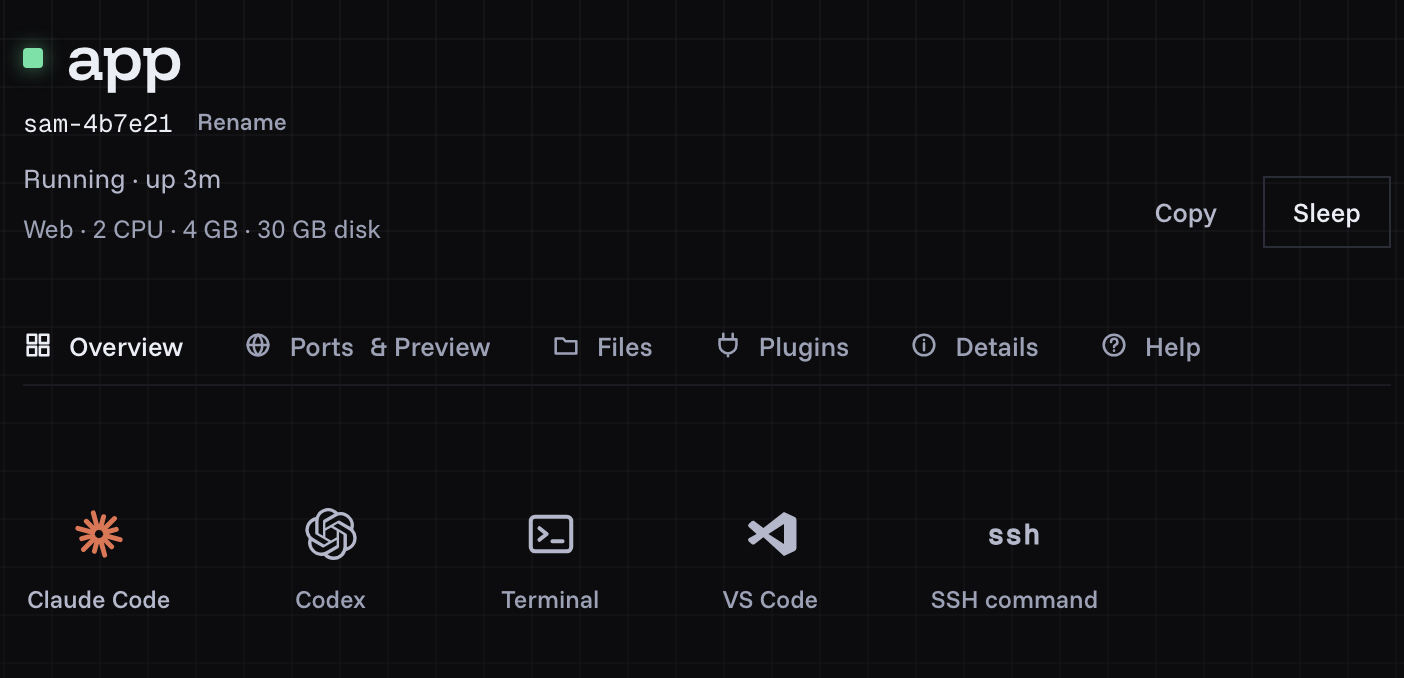
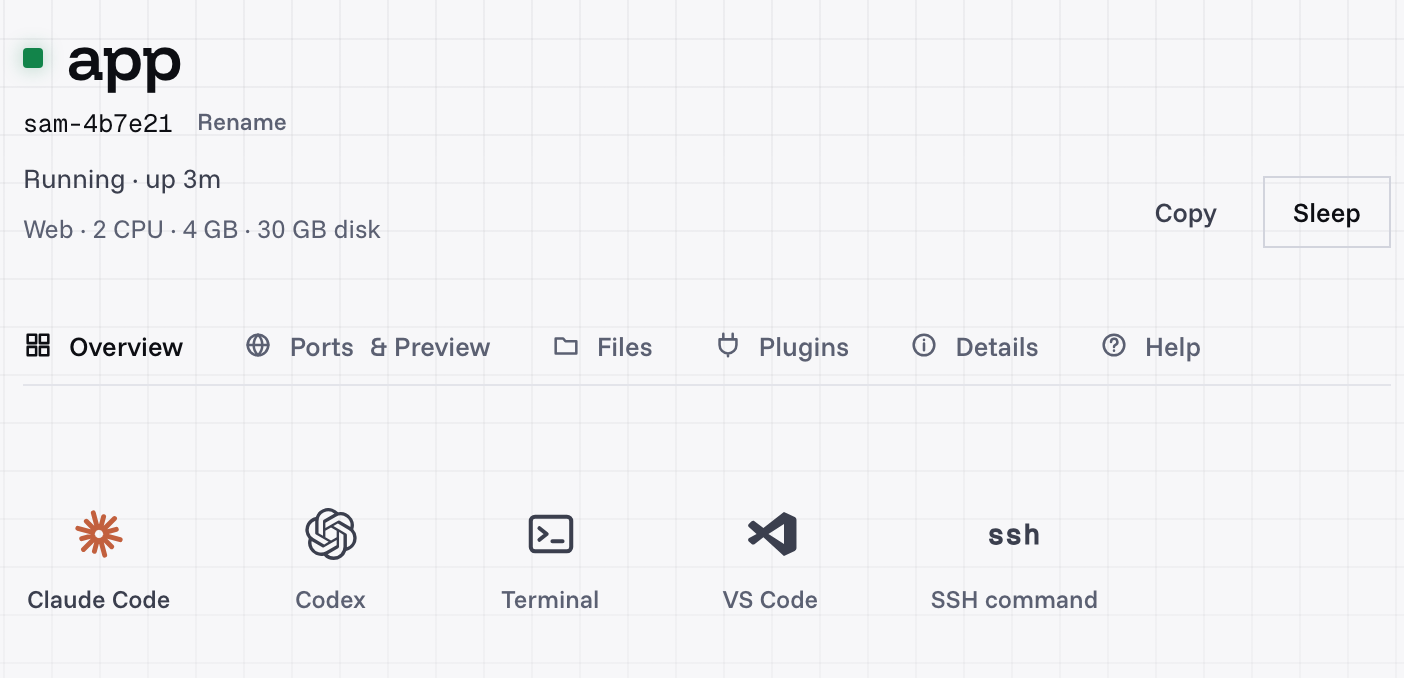
A shedix machine's page: Claude Code, Codex, a terminal, VS Code and SSH, one tap each.
## What does the same box cost for one hour?
Rivals' figures are their published per-vCPU and per-GB rates multiplied out, as of 2026-11-11, ordered by price:
| The same box for one hour | 2 vCPU, 4 GB | 4 vCPU, 8 GB | 8 vCPU, 16 GB | 16 vCPU, 32 GB | Included in the price |
|---|---|---|---|---|---|
| [shedix](/pricing) | $0.09/hr | $0.21/hr | $0.42/hr | $0.84/hr | 30–75 GB disk, Docker, Claude Code, Codex, VS Code and SSH |
| [Sprites](https://fly.io/sprites), at full use | $0.16 | $0.33 | $0.66 | Size not published | Storage extra |
| [E2B](https://e2b.dev/pricing) | $0.17 | $0.33 | $0.66 (on request) | $1.32 (on request) | 10–20 GiB included |
| [Daytona](https://www.daytona.io/pricing) | $0.17 | $0.33 | $0.66 (above its default limit) | $1.32 (above its default limit) | 5 GiB free |
| [Modal](https://modal.com/pricing) | $0.24 | $0.48 | $0.95 | $1.90 | Snapshots and volumes |
| [Vercel Sandbox](https://vercel.com/docs/vercel-sandbox/pricing), at full CPU | $0.34 | $0.68 | $1.36 | $2.73 (Enterprise) | Snapshots extra |
At every size a shedix machine costs 36–47% less than the same box on E2B, with 30–75 GB of disk included against
E2B's 10–20 GiB, and 56–63% less than on Modal. Sprites and Vercel Sandbox bill CPU on use, so their full-use figures
are a ceiling. shedix machines run in the United States, and a sleeping one wakes in under a minute. Machines sit on a
network where they can't reach each other in either direction; the [security page](/security) lists exactly what's kept
apart.
For a deeper look at the three sandbox services and shedix side by side, see
[Daytona vs E2B vs Modal vs shedix](/blog/daytona-vs-e2b-vs-modal).
## Which one should you pick?
- **Stay on E2B** if your app runs brief pieces of code in fresh sandboxes, or pauses them mid-task with memory and
resumes later.
- **Daytona** if you want long-lived sandboxes your team can open a shell in.
- **Modal** if you already run Python or GPU jobs there.
- **Sprites** if the box mostly waits and you want CPU billed only as it's used.
- **Vercel Sandbox** if your app already lives on Vercel.
- **shedix** if you want to give each agent a real computer: a whole VM with a full desktop, root, Docker, its own
public address and every way in. Your agent can start and drive it, shares a browser with you on it, and finds Claude
Code and Codex ready; it sleeps by itself and you pay only while it works. Run
[many agents at once](/use-cases/many-at-once), each on its own machine, without loading your laptop.
Choosing between a sandbox and a machine in the first place?
[Sandbox or whole machine for coding agents](/blog/sandbox-or-whole-machine-for-coding-agents) answers that question,
and [Containers, microVMs and full VMs](/blog/container-microvm-or-vm-for-coding-agents) covers what each kind of
isolation protects.
Prices and limits change, so check each provider's own pricing before you choose.
## What to do next
[Start a shedix machine](/) with one tap and open it in your browser; your first 12 hours of compute are on us. Or let
your agent start one itself: `npx skills add shedix-dev/skills` installs the [shedix skill](/skills).
[Who makes shedix](/about) is on its own page.